

Table of Contents
- What to Know Before You Choose a Hunting Knife
- Fixed Blade vs. Folding Hunting Knife: Which One Is Right for You
- Hunting Knife Blade Shapes Explained
- Best Steel for Hunting Knives: Carbon Steel vs. Stainless Steel
- Handle Materials, Ergonomics, and Grip Texture
- Sheath Types, Carry Systems, and Legal Restrictions
- Sharpening, Honing, and Long-Term Knife Maintenance
- Budget Tiers, Buy-It-for-Life Value, and How to Choose a Hunting Knife That Lasts
Last Updated: August 2, 2026
Knowing how to choose a hunting knife is one of the most consequential gear decisions a hunter makes. This guide from Rapid River Knifeworks cuts straight to what matters: blade geometry, steel selection, handle ergonomics, and carry systems that hold up in the field. A razor-sharp edge on the right blade profile, paired with a handle that fits your grip, will outperform a beautiful knife with the wrong geometry every single time.
What to Know Before You Choose a Hunting Knife
Choosing a hunting knife starts with one honest question: what will you actually use it for? A common mistake is buying a single "do-everything" knife without thinking through specific tasks. Field dressing a whitetail deer involves different demands than processing small game, skinning elk, or general camp use.
Field Dressing vs. General-Purpose Use
Field dressing demands precision above bulk. You need a blade that can open a body cavity cleanly without puncturing organs, which means a controlled tip geometry and a blade thin enough for detail work. A gut hook is the most specialized tool for this task: a small, sharpened hook on the spine of the blade that scores the hide without the blade tip entering the cavity.
General-purpose hunting knives prioritize versatility. They handle skinning, boning, camp tasks, and occasional processing work. For most hunters who take one or two animals per season, a well-chosen general-purpose blade covers the full range of field tasks.
Blade Length Considerations by Game Size
Blade length is a practical specification, not a preference. Matching blade length to game size reduces fatigue and improves control.
Game Size |
Recommended Blade Length |
Primary Use |
|---|---|---|
Small game (rabbit, squirrel) |
2.5 - 3.5 inches |
Skinning, detail work |
Medium game (deer, antelope) |
3.5 - 4.5 inches |
Field dressing, skinning |
Large game (elk, bear) |
4.5 - 5.5 inches |
Heavy skinning, boning |
Big game processing |
5.5 - 6+ inches |
Breaking down quarters |
Longer blades are not inherently better. On small game, a 5-inch blade is unwieldy. On elk, a 3-inch blade means extra passes and fatigue.
Fixed Blade vs. Folding Hunting Knife: Which One Is Right for You
Fixed blade hunting knives are the stronger, more reliable choice for serious field work. A fixed blade has no moving parts to fail, no pivot point to collect blood and debris, and no lock mechanism to weaken under lateral pressure. For field dressing, skinning, and any task requiring sustained force, a fixed blade is the correct tool.
Folding hunting knives offer portability and discretion. They fit easily in a pocket and work well as compact backup blades. The trade-off is real: a folding knife requires more maintenance to keep the pivot clean, and the blade-to-handle junction is always a structural weak point compared to a fixed blade.
For most hunters: carry a fixed blade as your primary field knife and a folding knife as a secondary tool if needed.
Full Tang vs. Partial Tang Construction
Full tang is a construction method where the steel of the blade extends the full length and width of the handle, with handle scales attached on either side. Full tang construction is the standard for hunting knives that will face real field stress.
Partial tang knives have a narrower steel extension that runs only partway into the handle. They are lighter and less expensive to produce, but they carry a genuine risk of handle separation under heavy use or lateral force.
For field dressing and skinning, where you apply consistent pressure and occasional torque, full tang construction is non-negotiable.
Hunting Knife Blade Shapes Explained
Blade profile determines how a knife performs across specific tasks. This is where most hunters make their first mistake.
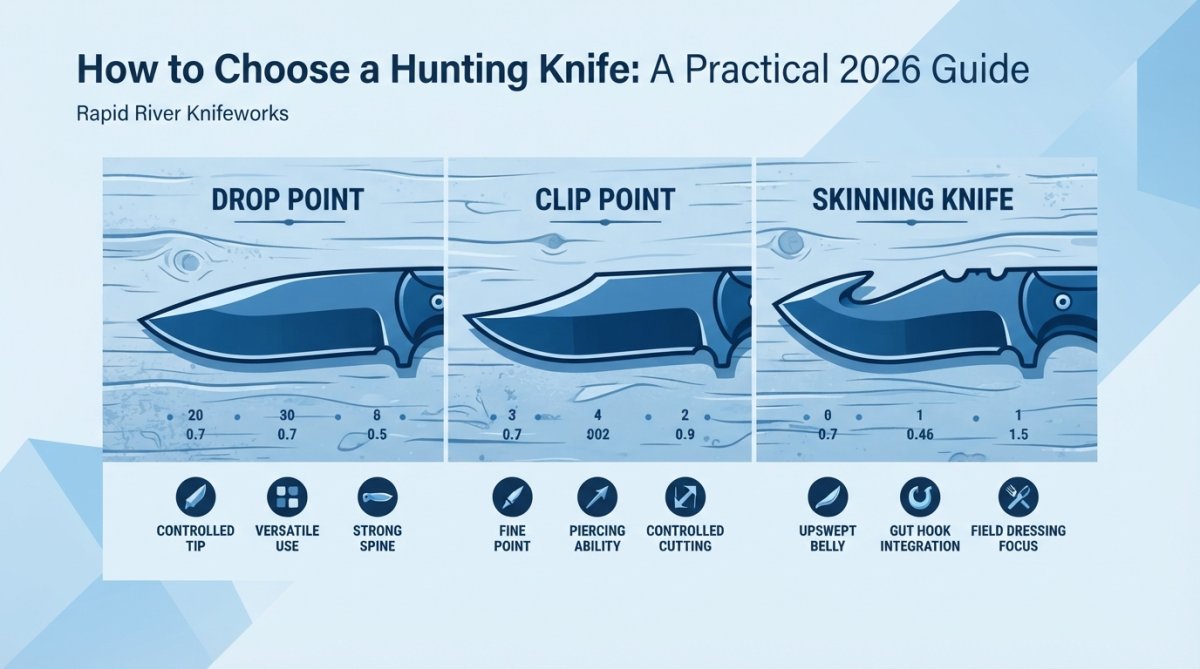
Drop Point, Clip Point, and Skinning Knife Profiles
Drop point is the most versatile hunting blade profile. The spine curves gently downward toward the tip, creating a strong, controllable point and a long, curved belly ideal for skinning. Drop point blades are the correct choice for hunters who want one knife that handles field dressing, skinning, and light camp tasks. The lowered tip reduces the risk of accidental puncture during field dressing.
Clip point blades feature a concave cutout near the tip, creating a finer, more acute point. This profile excels at detail work and piercing, making it popular for small game and hunters who prioritize tip precision.
Skinning knife profiles prioritize belly. The blade curves dramatically upward, maximizing the arc of cutting edge that contacts hide during long skinning strokes. A dedicated skinning knife is the right choice for big game hunters who process multiple animals per season.
Gut Hook and Blade Geometry for Field Dressing
A gut hook is a sharpened, semi-circular notch on the spine of the blade, positioned near the tip. It is designed for one specific task: opening the abdominal cavity of big game without the blade tip contacting internal organs.
Gut hooks work well for hunters who field dress frequently and want speed. They require a dedicated sharpening tool, typically a tapered ceramic or diamond rod, because a standard sharpening stone cannot reach the interior of the hook. If you are not willing to maintain the gut hook, the feature becomes a liability.
Blade geometry beyond profile includes spine thickness and grind type. A thinner spine with a hollow grind produces a razor-sharp edge that excels at skinning but dulls faster under hard use. A thicker spine with a flat or convex grind holds an edge longer and handles heavier tasks, but requires more skill to sharpen.
Best Steel for Hunting Knives: Carbon Steel vs. Stainless Steel
Steel selection determines the trade-off between edge retention and corrosion resistance. According to the American Bladesmith Society's technical resources on steel selection, the performance of any steel is determined by its heat treatment as much as its alloy composition.
Edge Retention, Blade Hardness, and the Rockwell Scale
Blade hardness is measured on the Rockwell C scale, typically abbreviated as HRC. Most hunting knives fall between 56 and 62 HRC. Higher HRC values indicate a harder steel that holds a sharper edge longer but becomes more brittle and more difficult to sharpen in the field. Lower HRC values produce a tougher blade that is easier to touch up on a sharpening stone but requires more frequent honing.
Carbon steel hunting knives offer exceptional edge retention and are significantly easier to sharpen to a razor-sharp edge in the field with minimal equipment. The trade-off is corrosion resistance: carbon steel requires drying and oiling after every use, particularly in wet environments.
Stainless steel hunting knives resist corrosion and require less maintenance between uses. Common stainless alloys include 440C, S30V, and VG-10, each offering a different balance of edge retention, toughness, and corrosion resistance. Most stainless steels are harder to sharpen in the field without proper tools.
For most hunters, a quality stainless steel in the 58-60 HRC range is the practical choice: corrosion resistance for field conditions, adequate edge retention for a full season, and sharpenable with a standard honing rod or sharpening stone.
Handle Materials, Ergonomics, and Grip Texture
A hunting knife handle is a safety feature, not a comfort feature. A handle that slips when wet, fatigues the hand during extended skinning, or creates hotspots during heavy use causes cuts and dropped knives.
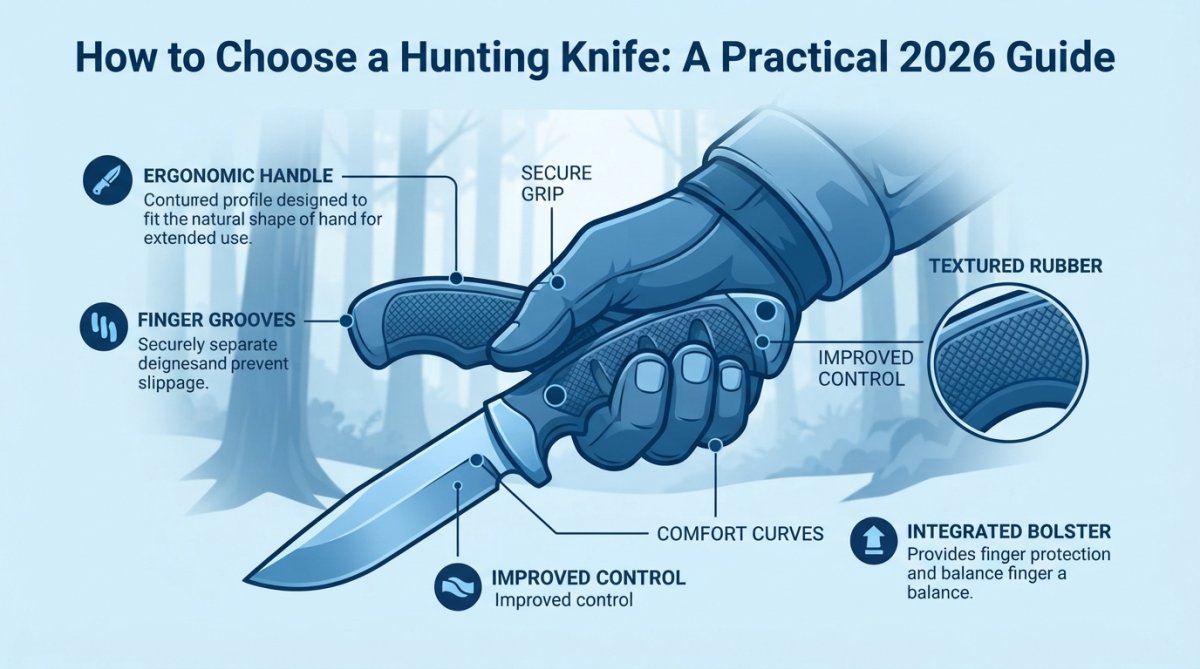
Handle materials each carry distinct performance profiles:
- G-10 and Micarta: Synthetic composite materials that provide excellent grip texture even when wet, resist temperature changes, and do not absorb moisture. The preferred choice for hunters who work in rain or snow.
- Rubber and Kraton: Maximum grip texture and shock absorption. Excellent for cold-weather use with gloves.
- Stabilized wood: Combines natural aesthetics with improved moisture resistance compared to raw wood.
- Bone and antler: Traditional materials with genuine grip texture. Require more maintenance and are sensitive to moisture over time.
Ergonomic handle design includes gimping (checkered or grooved texturing on the spine or handle), a bolster that prevents the hand from sliding onto the blade under pressure, and a lanyard hole for securing the knife during rappelling or water crossings.
If you hunt in wet conditions, prioritize synthetic materials. If you hunt in dry environments and value aesthetics alongside function, stabilized wood or quality synthetic composites both serve well.
Sheath Types, Carry Systems, and Legal Restrictions
The sheath is half the carry system and is routinely treated as an afterthought. A poorly designed sheath that allows the knife to shift, rattle, or deploy unexpectedly is a genuine safety hazard. A well-designed sheath keeps the blade secure, accessible, and protected.
Kydex vs. Leather Sheath: Pros and Cons
Kydex is a thermoplastic material molded to the exact profile of a specific knife. It holds the blade with a positive retention click, resists moisture completely, and requires essentially no maintenance. Kydex sheaths are the functional choice for hunters who work in wet environments or who need a secure carry system during active movement.
Leather sheaths are traditional, quiet, and aesthetically superior to Kydex for most collectors and hunters who value craftsmanship. Quality leather protects the blade and molds slightly to the knife over time. Leather must be conditioned periodically, and wet leather that dries without conditioning can stiffen and crack.
Sheath Type |
Moisture Resistance |
Maintenance |
Retention |
Best For |
|---|---|---|---|---|
Kydex |
Excellent |
None |
Positive click |
Wet climates, active hunting |
Leather |
Moderate |
Regular conditioning |
Friction fit |
Dry climates, traditional carry |
Nylon/Cordura |
Good |
Minimal |
Snap closure |
Budget carry, backup knife |
Blade Length Laws and State Restrictions in the U.S.
Carrying a hunting knife legally requires understanding state and local laws, which vary significantly across the United States. Many states regulate concealed carry of fixed blades above a certain length, typically ranging from 3 to 5 inches, while others restrict specific blade types regardless of length. The Knife Rights Foundation's state knife law guide maintains a regularly updated database of knife laws by state.
Know your state's law before you carry, and know the laws of any state you travel through with a hunting knife in your vehicle.
Sharpening, Honing, and Long-Term Knife Maintenance
A hunting knife's performance is determined as much by maintenance as by its initial quality. A razor-sharp edge on an average knife outperforms a dull edge on an exceptional one.
Honing realigns the microscopic edge of the blade without removing material. A honing rod, used regularly before and after field use, keeps the edge performing at its best between full sharpenings. Ceramic honing rods work on both carbon and stainless steels.
Sharpening removes material to re-establish the edge geometry. A quality sharpening stone, whether a whetstone or a diamond plate, is the most effective tool for restoring a dull hunting knife. The key variable is maintaining a consistent angle, typically 15 to 20 degrees per side for most hunting knives.
Field maintenance requires minimal equipment: a small ceramic rod or a folding diamond sharpener fits in any pack and handles touch-ups between sharpening sessions at home. Long-term maintenance for carbon steel knives includes cleaning, drying, and applying a thin coat of food-safe mineral oil or blade oil after every use. Stainless steel knives require less attention but benefit from periodic cleaning and light oiling.
Budget Tiers, Buy-It-for-Life Value, and How to Choose a Hunting Knife That Lasts
The hunting knife market segments into three functional tiers, and the right choice depends on how frequently you hunt and what you demand from your tools.
Entry-level knives cover basic field tasks and represent the lowest barrier to getting a functional tool in hand. Quality varies significantly at this tier: some use adequate steel and simple but functional designs, while others use unspecified alloys and poor heat treatment that results in edges that fold rather than cut. Research the steel specification before purchasing.
Mid-range knives represent the best value for most hunters. At this tier, you access quality steel specifications, full tang construction, and ergonomic handle designs that hold up across seasons. Many hunters who start here never feel the need to move up.
Premium and hand-crafted knives are where construction quality, material selection, and craftsmanship converge into tools built for a lifetime of use. Rapid River Knifeworks operates in this tier: hand-crafted knives built since 2002, with a lifetime warranty that reflects genuine confidence in construction quality. For hunters who want a knife they will never replace, and who value American-made craftsmanship from a Michigan-based maker, this tier delivers tools that improve with use and carry real provenance.
The buy-it-for-life calculation is straightforward: a premium hand-crafted knife purchased once, maintained properly, and backed by a lifetime warranty costs less over a decade than replacing mid-range knives that wear out or fail.
Common Mistakes to Avoid When Buying a Hunting Knife
Most hunting knife buying mistakes are preventable:
- Prioritizing blade length over blade geometry. A 6-inch blade with the wrong profile is less useful than a 4-inch blade with the right one.
- Ignoring steel specifications. Any knife sold without a named steel alloy and hardness rating is a risk.
- Buying partial tang for field use. Partial tang knives are appropriate for light kitchen tasks, not sustained field pressure.
- Neglecting the sheath. A knife without a quality carry system is incomplete.
- Skipping maintenance. Even the best steel dulls without regular honing.
- Overlooking state carry laws. Know the regulations before you carry.
The real difference between a hunting knife that serves you for decades and one that disappoints comes down to matching specifications to actual use, buying full tang and quality steel, and committing to regular maintenance.
Frequently Asked Questions
Fixed blade vs. folding knife: which is better for hunting?
For most hunting tasks, a fixed blade is the stronger choice. Fixed blade knives with full tang construction are more durable under pressure, easier to clean after field dressing, and have no mechanical parts to fail in cold or wet conditions. Folding knives offer more compact carry and are better suited for EDC or small game. If you field dress big game regularly, a fixed blade with a secure leather or Kydex sheath is the practical standard.
What steel type is best for a hunting knife?
The best steel for a hunting knife depends on your conditions. Carbon steel holds a razor-sharp edge and is easier to hone in the field, but it requires drying and oiling to prevent rust. Stainless steel offers strong corrosion resistance, making it better for wet environments like fishing or waterfowl hunting. High-quality stainless alloys can match carbon steel for edge retention. Look at the Rockwell scale rating: most hunting knives perform well in the 57-62 HRC range.
How do I choose the right blade shape for skinning vs. gutting?
A drop point blade is the most versatile hunting knife shape and handles both skinning and gutting on big game and small game. Its controlled tip reduces the risk of puncturing organs during field dressing. A dedicated skinning knife has a more curved belly for peeling hide efficiently. If you want a single knife for gutting, look for one with a gut hook built into the spine. Clip point blades offer a finer tip for precise work but are less forgiving on heavy hide.
Are there legal restrictions on hunting knife blade length in the U.S.?
Yes. Blade length laws vary significantly by state and sometimes by city or county. Many states restrict concealed carry of fixed blade knives over a certain length, commonly 3 to 4 inches, in public spaces. In the field during hunting season, regulations are generally more permissive, but you should always check your state's fish and wildlife statutes and local ordinances before carrying. Transporting a hunting knife in a vehicle also falls under state-specific rules in some jurisdictions.
How do I sharpen and maintain a hunting knife in the field?
Carry a compact sharpening stone or ceramic rod for field touch-ups. After each use, wipe the blade clean and dry it completely before sheathing to prevent corrosion, especially with carbon steel. Honing realigns the edge without removing steel; do this regularly between full sharpening sessions. At home, use a whetstone to restore a dull edge, working at a consistent angle of roughly 15 to 20 degrees per side. Oil the blade lightly before long-term storage.
Does a hand-crafted hunting knife actually perform better than a mass-produced one?
Hand-crafted knives often feature tighter tolerances in blade geometry, more consistent heat treatment, and handle fits that mass production lines skip for cost reasons. For hunters who use their knife hard and often, those details translate to better edge retention, a more secure grip, and longer service life. The difference becomes most apparent over years of use. A hand-crafted knife from an established American maker is also more likely to come with a meaningful lifetime warranty backed by direct accountability.
This article was written using GrandRanker